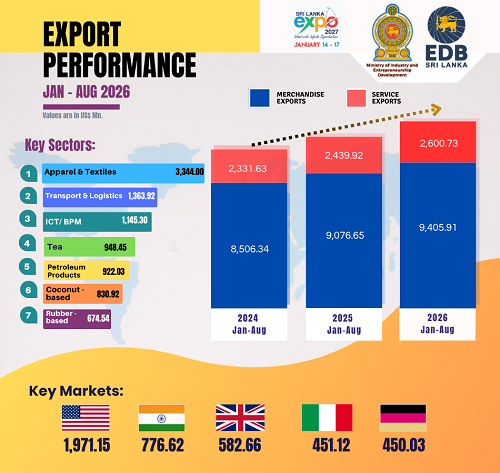
Sri Lanka’s exports surpassed the US$12 billion mark during the first eight months of 2026, rising 4.26% year-on-year to US$12.01 billion, as growth in services and several value-added manufacturing sectors helped offset weakness in apparel and traditional exports.
Merchandise exports increased 3.63% to US$9.41 billion, while services exports grew by a stronger 6.59% to US$2.60 billion, according to provisional data from Sri Lanka Customs and estimates for gems and jewellery and petroleum products.
The growth momentum continued in August, although at a slower pace. Total exports rose 1.77% year-on-year to US$1.60 billion, with merchandise exports declining 1% to US$1.27 billion while services exports jumped 13.97% to US$331.87 million.
The export structure is showing signs of increasing diversification. During January-August, electrical and electronic components emerged as one of the fastest-growing sectors, with exports surging 57.49% to US$440.31 million. Food and beverages grew 19.99% to US$462.52 million, while spices and essential oils increased 24.09% to US$355.78 million. Rubber and rubber-based products rose 5.51% to US$674.54 million and coconut-based products grew 5.63% to US$830.92 million.
ICT/BPM exports also continued to expand, rising an estimated 9.76% to US$1.15 billion during the first eight months, reinforcing the growing role of services in Sri Lanka’s foreign exchange earnings.
However, the country’s largest merchandise export sector, apparel and textiles, remained under pressure. Earnings fell 6.76% to US$3.34 billion, with exports to the United States, European Union and United Kingdom declining 5.09%, 6.94% and 11.15%, respectively. Tea exports also fell 7.56% to US$948.45 million, while seafood exports declined 2.89%.
Export markets also showed significant shifts. The United States remained Sri Lanka’s largest merchandise market, accounting for about 20.7% of exports, but earnings declined 2.09% cumulatively to US$1.97 billion. India strengthened its position as the second-largest destination, with exports rising 10.15% to US$776.62 million, overtaking the United Kingdom.
China and Turkey recorded particularly strong growth. Exports to China increased 17.39% to US$208.92 million, while exports to Turkey almost doubled, rising 99.95% to US$187.53 million.
The European Union, which accounts for around 22.2% of Sri Lanka’s merchandise exports, remained broadly stable, with cumulative exports edging down 0.42% during the period.
The Export Development Board said sustaining the momentum would require greater value addition, innovation, technology adoption, market diversification and deeper integration into global value chains. The performance during the first eight months indicates that while traditional export sectors continue to face difficult global conditions, faster-growing manufacturing and services sectors are beginning to play a larger role in Sri Lanka’s export earnings.
Subscribe to our newsletter to get notification about new updates, information, etc..
