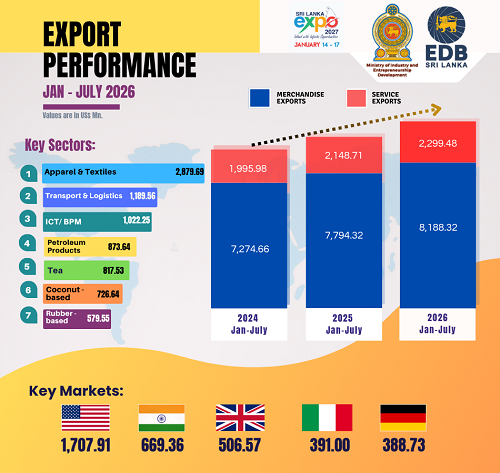
Sri Lanka’s total exports crossed the US$10 billion mark during the first seven months of 2026, reaching an estimated US$10.49 billion, a 5.5% increase over the corresponding period of last year, according to the Sri Lanka Export Development Board (EDB).
Merchandise exports rose 5.05% year-on-year to US$8.19 billion during January-July, while services exports grew at a faster pace of 7.02% to an estimated US$2.30 billion.
In July alone, total exports increased 2.63% year-on-year to an estimated US$1.64 billion. Merchandise exports, however, fell 1.3% to US$1.29 billion, while services exports increased 3.75% to US$351.92 million.
The overall export performance was supported by strong growth in several value-added sectors. Electrical and electronic components recorded the highest growth during the first seven months, with earnings rising 57.69% to US$377.91 million. Exports of insulated wires and cables increased 86.28%, while exports of telephone sets and audio/video equipment rose 232.72%.
Food and beverage exports increased 19.23% to US$405.22 million, driven largely by a 33.11% increase in processed food exports. Spice and concentrate exports rose 14.32% to US$280.49 million, with cinnamon earnings increasing 29.75%.
Coconut-based exports grew 10% to US$726.64 million, supported by higher earnings from fibre-based and shell-based products. Rubber and rubber-based exports increased 4.92% to US$579.55 million.
Services exports also continued to expand, with ICT/BPM earnings estimated at US$1.02 billion during January-July, up 14.54% year-on-year.
The gains in these sectors partly offset weakness in some of Sri Lanka’s traditional export industries. Apparel and textile exports declined 6.50% to US$2.88 billion, with shipments to the United States, European Union and United Kingdom falling 2.99%, 8.42% and 11.06%, respectively.
Tea exports fell 7.53% to US$817.53 million, while seafood exports declined 3.73% to US$138.08 million.
The United States remained Sri Lanka’s largest merchandise export market, accounting for around 22% of total merchandise exports. Exports to the US declined marginally by 1.10% to US$1.71 billion during January-July.
India strengthened its position as the country’s second-largest export destination, with cumulative exports increasing 36.16% to US$688.47 million according to the EDB’s overall destination data. Exports to Turkey also recorded substantial growth, rising 92.48% to US$152.87 million.
The United Kingdom, meanwhile, saw exports decline 10.23% to US$434.44 million during the first seven months.
Exports to the European Union, which accounts for around 25.5% of Sri Lanka’s merchandise exports, declined marginally by 0.50% during January-July, despite a sharper 14.59% fall in July. Italy remained the largest EU market, with exports rising 2.93% to US$391 million, while exports to Germany, the Netherlands and France declined.
EDB Chairman and CEO Mangala Wijesinghe said the crossing of the US$10 billion threshold reflected the resilience of Sri Lankan exporters despite uncertainties in global trade.
He said the focus would now be on improving competitiveness, developing new products and markets, increasing value addition, adopting technology and integrating Sri Lankan businesses more deeply into global value chains.
The export data, compiled from Central Bank of Sri Lanka and Sri Lanka Customs information, indicate that growth is becoming increasingly diversified, although the continued weakness in apparel, tea and some traditional markets remains a challenge for the sector.
Subscribe to our newsletter to get notification about new updates, information, etc..
