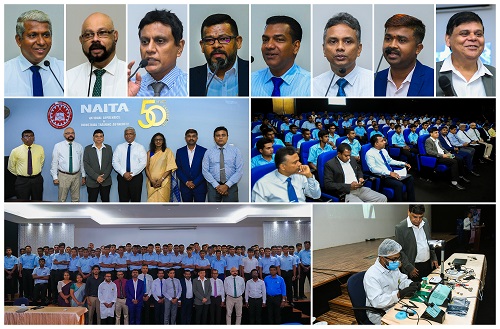
The Sri Lanka Export Development Board (EDB) has taken a step towards strengthening the country’s skilled workforce for the electronics and electrical manufacturing sector through a first-of-its-kind capacity-building workshop conducted in partnership with India’s Global Electronics Association and the National Apprentice and Industrial Training Authority (NAITA).
The seminar and practical workshop on hand soldering and wire harness techniques, held on 13 August 2026 at the NAITA headquarters, brought together more than 150 participants, including around 100 students undergoing training in automobile, electronics, electrical and related technical fields.
The initiative is significant in the context of Sri Lanka’s efforts to expand its presence in higher-value manufacturing and exports. The availability of industry-ready technical personnel remains a key requirement for attracting investment and enabling local manufacturers to integrate more deeply into global electronics supply chains.
The Global Electronics Association, formerly known as IPC, supports electronics manufacturers and suppliers through internationally recognised standards covering areas including electronic assembly, printed circuit boards, cable and wire harness manufacturing and quality assurance. Its standards are widely used across global manufacturing industries.
The collaboration with its Indian chapter is expected to help bring international manufacturing practices and technical standards into Sri Lanka’s vocational training system.
The workshop combined technical presentations with practical demonstrations, covering emerging technologies, manufacturing processes, quality standards and regulatory compliance. Representatives of leading electronics manufacturers and industry associations also shared insights on the skills requirements of the sector.
Addressing the gathering, EDB Director General Erandike Dissanayake and NAITA Vice Chairman Pandula Medawatte highlighted the importance of developing a workforce capable of supporting the evolving needs of the electronics and electrical industry.
Speakers from the Global Electronics Association's India chapter, including Senior Regional Manager Vittal Vatar and Master IPC Trainer Saurabh Kumar Saxena, conducted technical sessions and soldering demonstrations. Industry representatives from GPV Lanka, Variosystems and the Sri Lanka Electronic and Electrical Manufacturers and Exporters Association (SLEEMEA) also contributed to the programme.
The EDB plans to build on the initiative by working with the Global Electronics Association and SLEEMEA to update and introduce NAITA courses and curricula incorporating IPC standards and modern soldering techniques.
Such reforms could help narrow the gap between vocational training and the requirements of export-oriented manufacturers, while creating clearer pathways for young people into technical employment.
Meanwhile, SLEEMEA is expected to explore a Memorandum of Understanding with NAITA to facilitate the recruitment of skilled trainees for the electronics and electrical manufacturing industry.
With Sri Lanka seeking to diversify its export base and move towards more technology-intensive manufacturing, the development of specialised technical skills will be critical. The partnership between the EDB, NAITA, industry and international technical bodies is therefore aimed at creating a stronger pipeline of skilled workers capable of supporting the future growth and competitiveness of Sri Lanka’s electronics and electrical exports.
Subscribe to our newsletter to get notification about new updates, information, etc..
