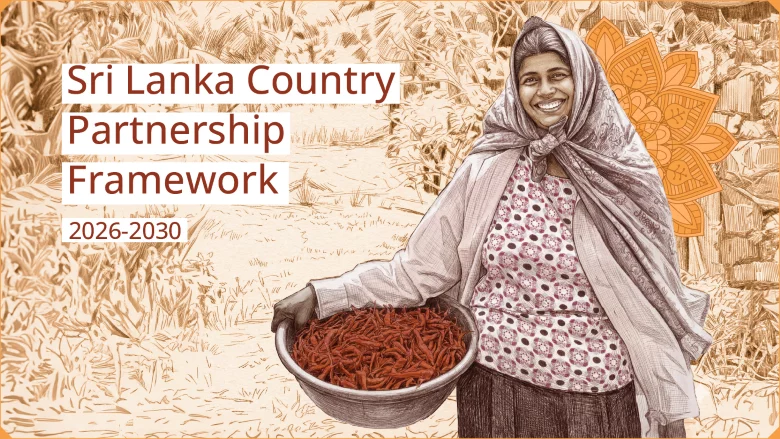
Sri Lanka and the World Bank Group have launched a new five-year Country Partnership Framework (CPF) aimed at supporting the island nation’s economic recovery, accelerating growth, and creating jobs through greater private sector investment.
The new framework seeks to help Sri Lanka achieve its medium-term economic growth target of more than 7%, while expanding employment opportunities as nearly one million young Sri Lankans are expected to enter the labour market over the next decade.
President Anura Kumara Dissanayake said the Government remains committed to maintaining macroeconomic stability and strengthening fiscal consolidation based on improved revenue performance.
“We are committed to building on the continued macroeconomic stability, strengthened governance and revenue-based fiscal consolidation that we have already achieved. Our goal is to confidently steer our economy towards strong, sustainable and inclusive growth,” he said.
The partnership places private sector-led job creation at its centre. Without stronger economic expansion and investment, the economy is projected to generate only about 300,000 formal jobs over the next decade, leaving a large share of young job seekers without quality employment.
According to Johannes Zutt, Sri Lanka’s economic recovery over the past three years has been “hard-won and impressive,” and the new framework is designed to ensure the benefits of growth are broadly shared.
The initiative will mobilise substantial financing from the World Bank Group. This includes more than $1 billion in direct and mobilised investment over five years from the International Finance Corporation (IFC) and up to $1 billion in concessional financing over the next three years from the World Bank.
Sarvesh Suri noted that Sri Lanka’s next phase of growth will depend on a dynamic private sector capable of competing and innovating.
“With its strategic location and skilled workforce, Sri Lanka is well-placed to expand its role in the region,” he said.
The framework focuses on four strategic priorities:
Improving the business environment: Measures will streamline regulations, modernise trade processes and expand digital government services to attract investment. These reforms are expected to support Sri Lanka’s goal of doubling annual export earnings to $36 billion by 2030.
Strengthening infrastructure: Planned investments include expanding the capacity of the Port of Colombo and attracting private operators to maintain its status as a key maritime hub. In the energy sector, the programme aims to help Sri Lanka generate 70% of electricity from renewable sources by 2030, including the addition of 1 gigawatt of new clean power.
Boosting tourism and agriculture employment: The initiative will support the Tourism Strategic Plan 2026–2030 while helping farmers access new technologies, markets and financing. Special attention will be given to the Northern and Eastern Provinces, which together account for less than 10% of the national economy despite their tourism and natural resource potential.
Enhancing resilience to shocks: Following the devastation caused by Cyclone Ditwah, which resulted in an estimated $4.1 billion in damages and affected 2.2 million people, the programme will fund improved early-warning systems and more resilient infrastructure.
Implementation of the partnership will begin immediately. The World Bank’s Board of Executive Directors has already approved the first project under the framework — the Regional Empowerment through Vibrant, Inclusive, and Viable Economies (REVIVE) Project, a $100 million investment focused on the Northern and Eastern provinces.
The REVIVE project will support economic development in key tourism and fisheries hubs including Jaffna, Pasikuda, Trincomalee and Arugam Bay. It will also provide targeted assistance to small businesses, particularly women-led enterprises.
The initiative is expected to create around 3,000 jobs and benefit approximately 260,000 people by 2031.
The World Bank Group has partnered with Sri Lanka for more than seven decades and currently supports 13 active projects valued at over $1.5 billion across sectors including education, health, energy, transport, agriculture and social protection. Between 2021 and 2026, the IFC alone has committed nearly $1.8 billion in financing to Sri Lanka’s private sector.
Subscribe to our newsletter to get notification about new updates, information, etc..
